The following are the main measures that can benefit industrial companies:
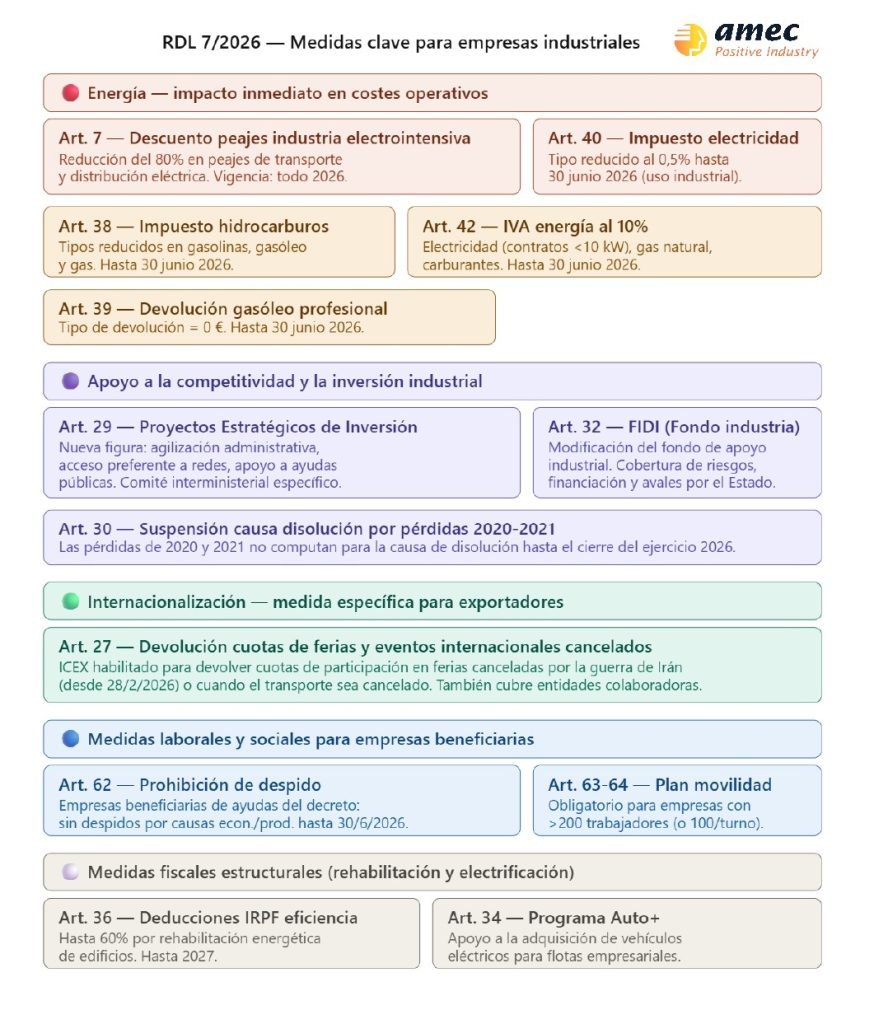
Energy Cost Reduction and Flexibility Measures
- Flexibilization of gas and electricity contracts: Until December 31, 2026, companies will be able to modify their contracted power or daily gas flows (and in the case of gas, even temporarily suspend the contract) without incurring the additional costs normally derived from these modifications. This makes it possible to adapt costs to variations in production.
- Reduction of tolls for the electro-intensive industry: An 80% reduction is established in the electricity bill corresponding to the access tolls to the transmission and distribution networks for consumers with an electro-intensive certificate during the whole year 2026.
- Zero gas storage fee: A zero euro subway gas storage fee is established for contracted capacity exceeding 20 days of consumption or firm sales, alleviating the cost of complying with strategic filling obligations.
- Reduction of the Special Tax on Electricity: The tax rate is reduced from 5.11% to 0.5% until June 30, 2026. For industrial uses, the minimum level of taxation is set at €0.5 per megawatt-hour.
_
Boosting Investment and Strategic Projects
- Strategic Investment Projects: This figure is created to identify and accelerate business initiatives with a high impact on reindustrialization and ecological transition. These projects will have preferential administrative processing, reduction of deadlines by half and priority in access and connection to electricity grids.
- Strategic Investment Committee: This body is established to prioritize and support projects that strengthen Spain’s strategic autonomy and economic security.
_
Decarbonization Support and Offsets
- Fund for the Promotion of Industrial Decarbonization (FIDI): The former electro-intensive fund is transformed into the FIDI to support investment in low-emission industrial technologies, mainly through carbon contracts for difference. These contracts guarantee a reference price for carbon, making viable investments that currently have higher operating costs than conventional processes.
- Compensation for indirect CO₂ costs: a credit supplement of €300 million is approved to finance aid for industrial sectors at risk of carbon leakage (such as steel, refining, aluminum, zinc, paper and inorganic chemicals) that are affected by the price of electricity derived from the gas market.
- Auto+ Program: Includes aid for companies to acquire electric and electrified vehicles, facilitating the decarbonization of their transportation fleets.
_
Tax and Financial Incentives
- Freedom of depreciation in Companies: Free depreciation is allowed (up to a maximum of 500,000 euros) for investments in self-consumption facilities of electric and thermal energy from renewable sources that replace fossil fuel systems. It also applies to new zero emission vehicles and new recharging infrastructures for professional use.
- Suspension of dissolution cause for losses: For fiscal year 2026, losses for the years 2020 and 2021 will not be computed for purposes of the dissolution cause for capital companies, allowing viable industrial companies with temporary difficulties to continue operating.
_
Specific measures for exporters
Refund of ICEX fees: If an industrial company had planned to participate in international trade fairs organized by ICEX that have been cancelled due to the conflict, it may request a refund of the fees paid and aid for non-recoverable expenses.
Who can request a refund?
There are three assumptions:
- Companies that have paid fees to participate in fairs or other international promotional activities organized by ICEX that have been cancelled as a result of the war in Iran (from February 28, 2026). In this case the refund is direct, without the need for additional justification.
- Companies that have paid their fee for an activity that has not been cancelled, but are unable to attend because the transportation in which they were going to travel has been cancelled. In this case, a justified request from the company is required.
- Companies that participated through ICEX collaborating entities (industry associations, chambers of commerce, etc.) and have incurred non-recoverable expenses due to cancellation. In this case, the aid can be channeled both to the participating company and to the collaborating entity itself.
The refund covers the participation fees paid. The decree does not explicitly mention other associated expenses (flights, hotels, stands), so in principle the refund is limited to the fees paid to ICEX or its collaborating entities.
It is important to note that companies benefiting from direct aid under this Royal Decree-Law are subject to a prohibition on dismissals due to causes derived from the current crisis until June 30, 2026; otherwise, they must reimburse the aid received.