JCV’s analysis shows a very clear evolution: shipping has gone from experiencing occasional episodes of tension to operating in an environment of much more recurrent volatility.
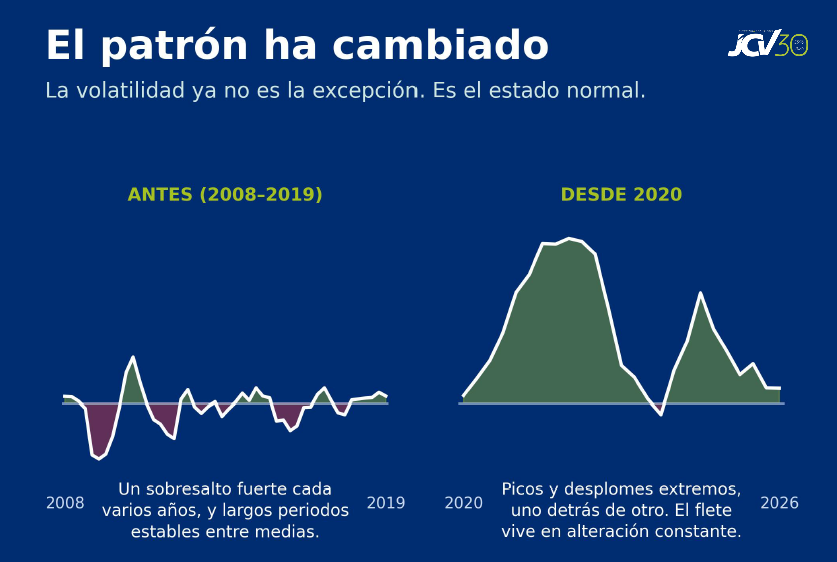
- Between 2008 and 2019, the sector experienced significant declines, but relatively spaced out over time: the financial crisis, overcapacity, the tariff war or pressure on margins generated significant shocks, although with periods of greater stability in between.
- From 2020, the pattern changes substantially. The pandemic led first to a drop in demand and then to heavy port congestion, container shortages and record freight rates. This context led shipping lines to achieve extraordinary margins, far removed from previous historical levels. According to JCV, the average operating margin reached 57.4% during the COVID cycle.
- After the normalization of 2023, volatility did not disappear, but changed in nature. The differential factor was no longer exceptional demand as during COVID-19, but the disruption of routes for geopolitical and maritime security reasons. Attacks in the Red Sea, detours around the Cape of Good Hope and recent tensions in the Middle East have shown that shipping lines’ profitability, transit times and logistics costs can be altered even without a global demand boom.
We are moving from a scenario of shocks separated by long stable periods to one of continuous “extreme peaks and troughs”. Volatility ceases to be a temporary exception and becomes a regular working condition.
The implication is clear: maritime logistics must be analyzed as a strategic variable, not just as an operational cost. For an internationalized company, the challenge is no longer just to get the best freight price at a given time, but to understand what risks may affect the next shipments, what routes may be altered, what alternatives exist and what margin of anticipation the company has.
This directly affects cost forecasting, commercial negotiation, inventory management, delivery schedules, international customer relations and the choice of incoterms. In markets where margins are tight or contracts are negotiated in advance, a sharp variation in logistics costs can alter the profitability of an operation or reduce the ability to meet committed deadlines.
JCV sums it up with a particularly relevant idea: “The real cost is not just the freight and FOB charges”. In a disruption-prone routing environment, the actual cost of an operation also depends on who bears the risk if the route changes, if there are transshipment alternatives, if the schedule bears additional delays and if the company has sufficient visibility to anticipate.
This is why international logistics management requires a more proactive approach. It is not just a matter of looking at how much it costs to transport goods today, but of assessing how the context may evolve over the coming weeks or months. Anticipating scenarios, reviewing critical routes, comparing logistical alternatives and adapting planning can make the difference between a manageable incident and a breakdown in the supply chain.